Architecting Human Systems
A systems thinker’s guide to leading humans
The leadership book for people who think in systems. Most leadership advice is written for people who lead by instinct. This one is for people who’d rather understand the system: why a team stalls, why good people disagree, and what to change so the whole thing runs. It turns twenty-five years of leading technology teams into principles you can carry, test and teach.
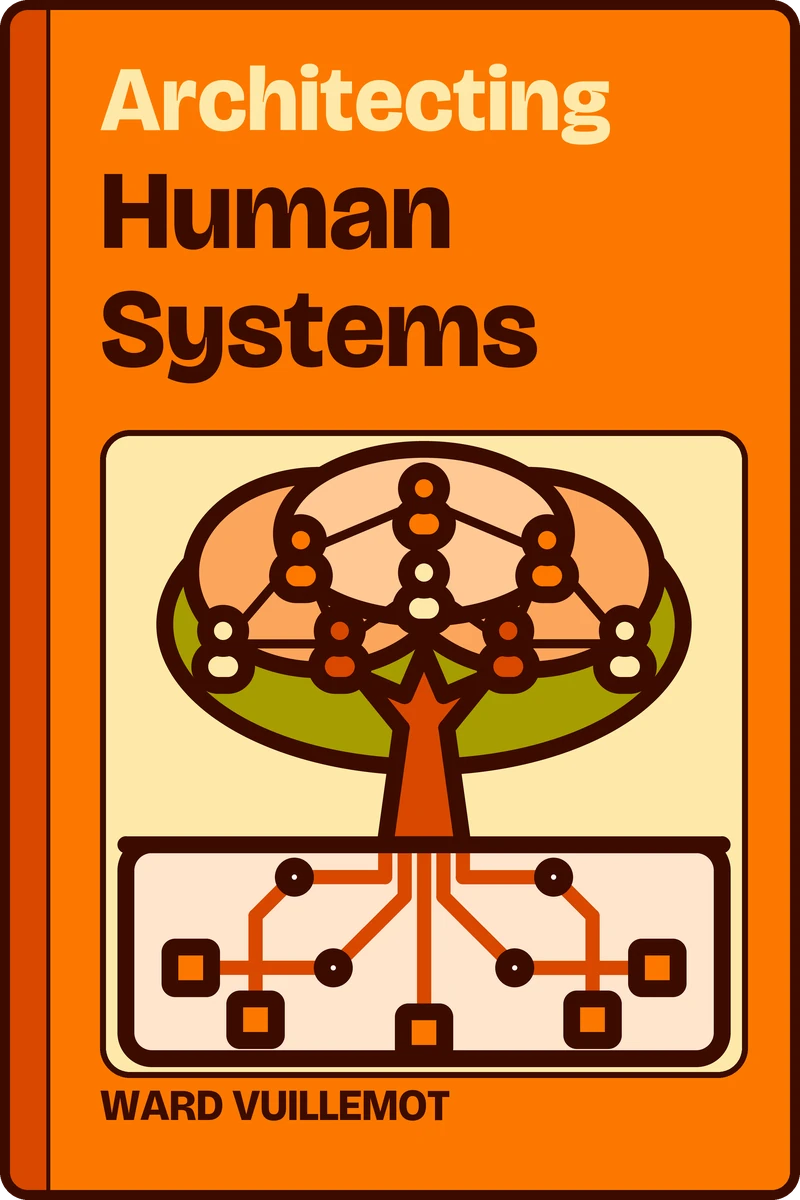
Organizations fail for the same reasons software fails. Not because the people are wrong. Because the architecture is wrong.
You already know how to architect a system. Clean interfaces. Clear ownership. No circular dependencies. You know what happens when the wiring is wrong — the whole thing deadlocks, and everyone points at someone else.
Human organizations fail the same way. For the same reasons. And architecture can be fixed.
Ward Vuillemot spent twenty-five years leading technology organizations at Boeing, Amazon, Xbox, Varsity Tutors, and RealSelf. What he built instead of instinct was a framework: a set of compact principles he calls the Leadership Maths — EQ > IQ, Influence > Authority, Say ≈ Do, Gardening > Carpentry. Each one is wrong in at least one situation and right in most others. That tension is the point.
The book begins with the simulation mind — how every brain builds its own private reality, and why your team sees ten different versions of the same meeting. It moves through the four needs every person brings to work: Direction, Community, Purpose, Trust. It arrives at the maths, at leading people who lead people, and at Silicon and Carbon: what AI changes about all of it, and what it doesn’t.
This is not a book of checklists. It is a grammar.
You’ll learn to:
- see why the people in one meeting leave with ten different versions of it
- spot which of four needs — Direction, Community, Purpose, Trust — is missing when a team stalls
- carry the principles as shorthand, and know what to do when two of them conflict
- make the shift from doing the work to leading people who lead people
- read an organization as a whole system, not a collection of people problems
- judge what AI changes about leadership, and what it doesn’t
History doesn’t repeat. But patterns rhyme across domains, if you know how to listen for the rhyme.
For engineers, architects, founders and anyone who leads people and thinks in systems — and has suspected the patterns rhyme.
What’s inside
- IThe Void How each of us builds a simulation of the world, why we defend it, and what happens when a team’s simulations collide.
- IIThe Self What people need from the systems they live in: direction, community, purpose, and trust.
- IIIThe Leadership Maths How a leader balances those needs with accountability and results, and what to do when they conflict.
- IVLeading Beyond Yourself The shift from doing the work to leading leaders, and seeing an organization as a system.
- VSilicon and Carbon Where people and machines meet, now that agents write much of the code.
Read the essays
Ideas from the book, as they’re written.
-
March 8, 2026
Why I Wrote a Personal Operating Guide (And Why Every Leader Should)
Most organizational dysfunction is caused by unspoken expectations, not incompetence. Writing down how you think and decide removes the guesswork.
-
October 6, 2020
Works in Progress Told in Three Truths
Be forgiving of your former self, firm of your present self, and flexible of your future self. Three truths about feedback, grace, and leading people who are all works in progress.
-
September 22, 2020
Fate or Destiny, What Do You Choose?
Fate is what happens when we don't decide. Destiny is the choices we make. A simple 2x2 of what we know and don't know shows why humility is a leader's best tool.
-
July 3, 2020
Leading Remotely: Creating Culture From Afar
Culture happens whether you want it to or not. How to build it remotely: say what you'll do, set explicit expectations, and reinforce through praise.
-
June 27, 2020
Leading Remotely: Lessons from 5+ Years in the Trenches
What five-plus years of leading 100% remotely taught me: remote-first is not remote-only, offices become optional, and the hard parts are time zones, pacing, and rapport.



About the author
Ward Vuillemot has spent more than twenty-five years building technology organizations — Boeing, Amazon, Xbox, Sears, Varsity Tutors, RealSelf — as an individual contributor, VP and CTO. He is autistic, and had to reverse-engineer the social intuition most leaders run on instinct — which meant building frameworks that, unlike reflexes, can be taught. He founded Monster Orange and writes at wardvuillemot.com. He is still learning. He considers this the best possible news. More about Ward.